PERSONALISED ATTENTION
 FREE SHIPPING TO MAINLAND SPAIN FROM 40€.
 ⭐ 9/10 RATING
 DISCRETED SHIPPING

Cannabis terpenes: to learn more
When we talk about cannabis and hemp, we usually think of cannabinoids such as CBD or THC. However, these plants contain many other compounds that contribute to their characteristics, including terpenes. terpenes.
These molecules are present in numerous plants and play a fundamental role in the creation of aromas and flavors. In cannabis, they help explain why some flowers have citrus notes, others resemble pine trees, and others have more earthy, floral, or spicy aromas.
But terpenes are much more than just aroma. Scientific research also studies their chemical characteristics, their possible interactions with other plant compounds, and their biological activity.
In this educational guide from Iguana Smoke we will learn What are terpenes, where are they found and what do we really know about them?, differentiating scientific results from claims that still do not have sufficient evidence.

Terpenes are a large and diverse class of organic compounds produced by a variety of plants, particularly conifers, which emit them from the leaves, flower buds, and stems. They are also produced by some insects, such as termites.
The Terpenes are a broad family of organic compounds produced by many plants. and that participate in the formation of their aromas and flavors.
They are not exclusive to cannabis. They are present, for example, in citrus fruits, lavender, rosemary, mint, hops, pine and many other plant species.
Numerous terpenes and terpenoids have been identified in cannabis. Among the most common are: Myrcene, limonene, α-pinene, linalool, β-caryophyllene and humulen.
From a chemical point of view, they are usually classified according to the number of isoprene units they contain. Cannabis strains that stand out especially are:
- Monoterpenes, such as myrcene, limonene, pinene and linalool.
- Sesquiterpenes, such as β-caryophyllene and humulene.
This classification is chemical and does not in itself indicate that a terpene has a certain effect on the body.
Where are the terpenes found in the cannabis plant?
In cannabis flowers, an important part of the terpenes is associated with the Glandular trichomes, These are microscopic structures that also produce and accumulate cannabinoids and other metabolites.
The trichomes are especially abundant in the female inflorescences and can be observed as small bright or crystalline dots on the surface of the flowers.
Within these structures, different volatile compounds are produced and stored. The combination of these compounds contributes to creating the characteristic chemical and aromatic profile of each flower.
Por eso, dos flores de cannabis pueden presentar aromas muy diferentes aunque ambas contengan CBD.
Why do cannabis flowers have different scents?
The smell of a flower does not depend on a single compound.
The aroma is a consequence of a complex mixture of volatile substances, Among these are terpenes, terpenoids and other aromatic compounds.
In addition, the composition can vary depending on different factors:
- Plant genetics.
- Variety or chemotype.
- Cultivation conditions.
- Maturation.
- Part of the plant analyzed.
- Harvest moment.
- Drying.
- Cured.
- Storage conditions.
The most recent research indicates that the aromatic diversity of cannabis is the result of the interaction of numerous compounds and genetic, environmental, and post-harvest processing factors.
Therefore, commercial terms such as “citrusy”, “terry”, “floral” or “spicy” mainly describe Sensory characteristics, Not necessarily physiological effects.
The main terpenes of cannabis
Although there are many different terpenes, some appear with particular frequency in the chemical profiles of cannabis.
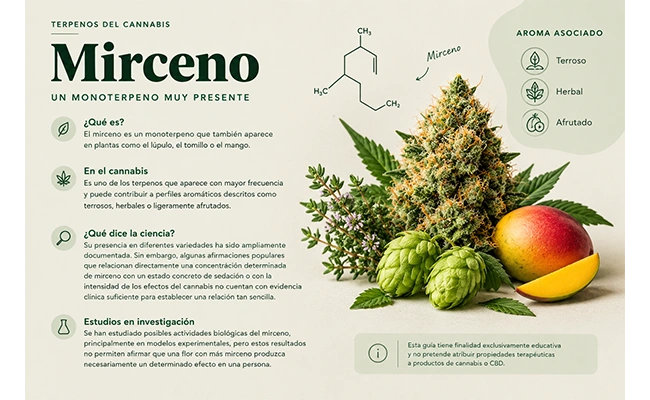
MIRCENO
The mirceno It is a monoterpene that is also found in plants such as hops, dill and mango.
In cannabis, it is one of the terpenes that appears most frequently and can contribute to aromatic profiles described as Terroso, herbal or slightly fruity.
Its presence in different varieties has been widely documented. However, some popular claims that directly link a certain concentration of myrcene to a specific state of sedation or to the intensity of the effects of cannabis do not have sufficient clinical evidence to establish such a simple relationship.
Associated aroma: Terroso, herbal, fruity.
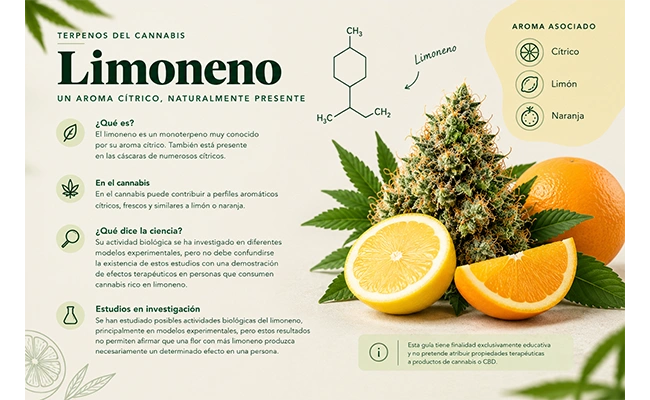
LIMONENE
The limonene It is a monoterpene known for its citrusy aroma. It is also present in the shells of numerous citrus fruits.
Cannabis can contribute to aromatic profiles citrus fruits, fresh and similar to lemon or orange.
Their biological activity has been investigated in different experimental models, but the existence of these studies should not be confused with a demonstration of therapeutic effects in people who consume cannabis rich in limonene.
Associated aroma: citrus, lemon, orange.
HUMULENO
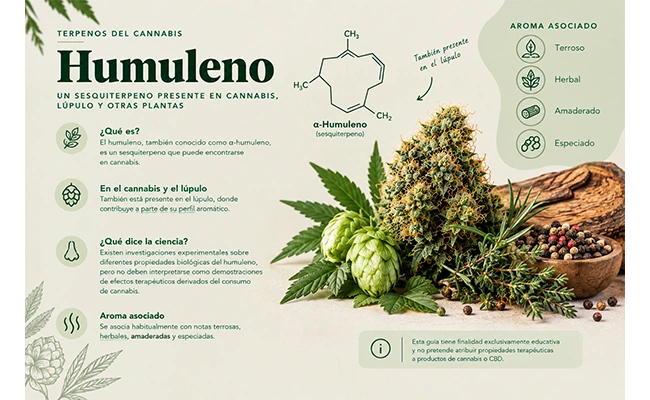
The humulene, Also known as α-humulene, it is another sesquiterpene that can be found in cannabis.
It is also present in the hops, where it contributes to part of its aromatic profile.
In cannabis it is usually associated with notes:
Associated aroma: Terroso, herbal, woody and spicy.
As is the case with other terpenes, there are experimental studies on the different biological properties of humulene, but they should not be interpreted as demonstrations of therapeutic effects derived from the consumption of cannabis.
LINALOOL
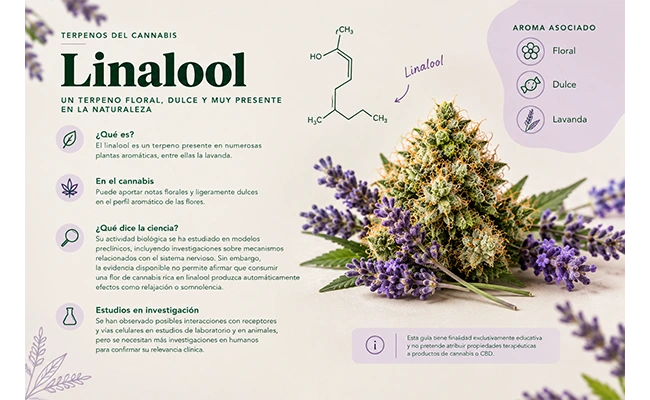
The Linalool It is a terpene present in numerous aromatic plants, including lavender.
In cannabis it can add notes floral and slightly sweet.
Its biological activity has been studied in preclinical models, including research on mechanisms related to the nervous system. However, the available evidence does not allow us to conclude that consuming a cannabis flower rich in linalool automatically produces effects such as relaxation or drowsiness.
Associated aroma: floral, sweet, lavender.
PINENO
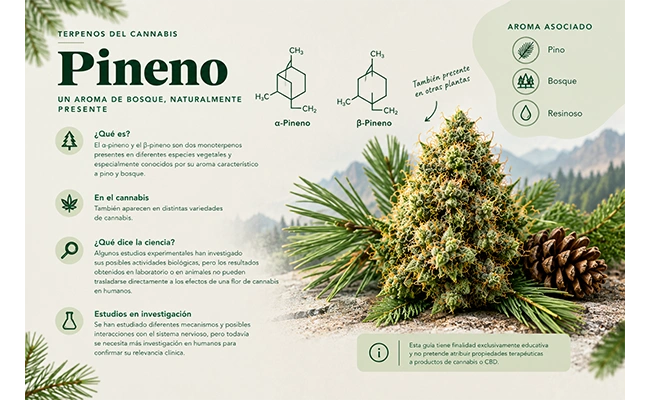
The α-pinene and the β-pinene They are two monoterpenes present in different plant species and especially known for their characteristic aroma. pine and forest.
They are also found in various varieties of cannabis.
Some experimental studies have investigated their possible biological activities, but the results obtained in the laboratory or in animals cannot be directly transferred to the effects of a cannabis flower in humans.
Associated aroma: pine, forest, resinous.
β-CARIOFILENO
The β-caryophyllene It is a sesquiterpene present in cannabis and also in spices such as black pepper, cloves or oregano.
Its scientific peculiarity is that, unlike many other terpenes, it has been shown to be interact with the cannabinoid receptor CB2. For this reason, some researchers have described it as a “phytocannabinoid” or a dietary cannabinoid.
This does not mean that β-caryophyllene produces the same effects as cannabinoids such as THC.
Its aromatic profile is usually described as:
Associated aroma: spicy, pepper, wood.
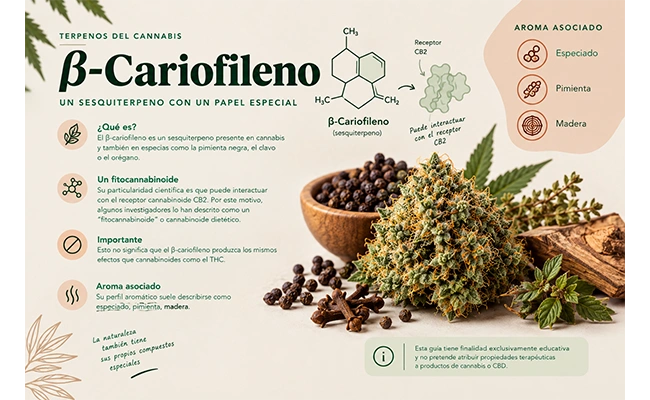
Table of the main terpenes
| Terpeno | Family | Typical aromatic profile |
|---|---|---|
| Myrcene | Monoterpeno | Terroso, herbal, fruity |
| Limonene | Monoterpeno | Citric, lemon, orange |
| Linalool | Monoterpeno | Floral, sweet, lavender |
| α-Pineno | Monoterpeno | Pine, forest, resinous |
| β-Pineno | Monoterpeno | Herbal, pine |
| β-Caryophyllene | Sesquiterpeno | Pepper, spices, wood |
| Hulmuleno | Sesquiterpeno | Herbal, earthy, woody |
Important: Aromatic profiles are indicative. The final aroma of a flower depends on the combination of numerous compounds and their relative concentrations.
Do terpenes have effects on the body?
This is one of the issues that causes the most confusion.
The terpenes They are not simply aromatic substances without biological activity. Some exhibit pharmacological activity in laboratory studies and animal models, and certain molecular mechanisms have been studied.
For example, β-caryophyllene can selectively activate the CB2 receptor, while other terpenes have shown different interactions with proteins, receptors, or cellular pathways.
However, it is necessary to distinguish three levels of evidence:
1. In vitro studies
They are performed on isolated cells, tissues or systems.
They allow us to study mechanisms, but They do not show that the same effect occurs in a person.
2. Studies in animals
They allow us to study how a whole organism responds.
They are important for research, but they do not automatically equate to results in humans.
3. Clinical studies in humans
They are necessary to determine whether an effect observed in the laboratory is clinically relevant and under what conditions.
In the case of many cannabis terpenes, the specific clinical evidence is still limited.
Therefore, expressions such as “limonene reduces anxiety”, “myrcene causes relaxation” or “linalool helps you sleep” should be used with great caution if they are presented as general statements about cannabis consumption.
The available scientific evidence is quite more complex.
Terpenes and cannabinoids: do they work together?
Terpenes do not necessarily act in isolation.
Cannabis contains a combination of Cannabinoids, terpenes and other plant compounds, Researchers have been studying for years whether these molecules can interact with each other.
This issue has given rise to the well-known concept of “sequencher effect”.
What is the sequelae effect?
The term entourage effect (encompañante efecto) is used to describe the hypothesis that different components of cannabis could interact with each other and modify their effects when present together.
The idea has generated great scientific interest because it suggests that an extract containing multiple components could behave differently than an isolated molecule.
However, it is important to make a distinction:
The sequelae effect is a scientific hypothesis that continues to be investigated, not a generally proven fact for all cannabis products.
A review published in 2023 concluded that the available evidence regarding the so-called cannabis entourage effect is still limited, contradictory, and inconclusive, especially when attempting to demonstrate that full-spectrum products necessarily produce therapeutic effects superior to those of isolated compounds.
A more recent review also points out that there are experimental results that suggest possible interactions between terpenes and cannabinoids, but that more studies are still needed to determine their pharmacological and clinical relevance.
Therefore, it is more scientifically correct to speak of Possible interactions or synergies in research It is a claim that any product containing multiple cannabinoids and terpenes automatically produces a synergistic effect.
What do we really know about terpenes?
The research allows us to draw some conclusions with considerable certainty:
✅We know that:
- Terpenes are natural components of many plants.
- Cannabis sativa L. produces a great diversity of terpenes.
- Terpenes contribute significantly to the aroma and flavor of flowers.
- Different varieties can have different terpene profiles.
- Glandular trichomes play an important role in the production and accumulation of these compounds.
- Some terpenes exhibit demonstrated biological activity in experimental studies.
- β-caryophyllene can interact with the CB2 receptor.
- The composition of terpenes can change during drying, processing, and storage.
⚠️ We still cannot state generally that:
- A certain terpene produces a specific effect in all people.
- A flower rich in a specific terpene must necessarily have a specific effect.
- The profile of terpenes alone can predict how a person will feel.
- All full-spectrum products should produce a synergistic effect.
- The properties observed in cellular or animal studies must be equivalent to therapeutic effects in humans.
This distinction is especially important when we talk about cannabis and health.
What happens to the terpenes after harvesting the plant?
Terpenes are volatile compounds, Therefore, they may be lost or transformed during processing and storage.
Drying can especially reduce the amount of some monoterpenes, while certain conditions of temperature, light, oxygen and humidity can also favor their degradation or transformation.
This explains why a freshly harvested flower and a flower stored for a long time can have differences in their aromatic profile.
For this reason, proper conservation is relevant for maintaining the organoleptic characteristics of a flower.
Si quieres explorar los distintos formatos y tipos disponibles en Iguana Smoke, puedes consultar la categoría específica de CBD flower and CBD buds.
How are terpenes analyzed?
To know what terpenes a sample contains, it is not enough to observe its smell.
The laboratories use analytical techniques capable of Identify and quantify the different compounds.
One of the most used techniques for analyzing terpenes is Gas chromatography, Often combined with mass spectrometry (GC-MS).
These techniques allow the different compounds present in a sample to be separated and determined which are present and in what concentration.
Therefore, when a laboratory analysis includes a profile of terpenes, it provides much more objective information than a simple aromatic description.
Terpenes: aroma, composition and science
Terpenes are one of the components that make each cannabis flower have a particular chemical and aromatic profile.
The mirceno, the limonene, the Linalool, the pine trees, the β-caryophyllene and the humulene They are some of the best-known compounds, but they are far from being the only ones.
Science is also investigating how these compounds interact with cannabinoids and with other components of the plant.
The important thing is to distinguish what we know from what we are still investigating.
Terpenes have a clear function in the Aromatic and chemical profile of cannabis, They have interesting biological properties in research, but there is still not enough clinical evidence to convert the terpene profile of a flower into a reliable predictor of its effects on a person.
In other words: The aroma can tell us a lot about the composition of a flower, but it does not by itself allow us to predict its effects.
Bibliography and scientific sources
- Booth, J. K., & Bohlmann, J. (2019). Terpenes in Cannabis sativa – From plant genome to humans. Plant Science, 284, 67–72.
- Nahar, L., Onder, A., & Sarker, S. D. (2021). The Cannabis Terpenes. Molecules, 25(24), 5792.
- Booth, J. K., & Bohlmann, J. (2019). Terpenes in Cannabis sativa – From plant genome to humans. Plant Science.
- Leghissa, A., Hildenbrand, Z. L., & Schug, K. A. (2018). A review of methods for the chemical characterization of cannabis natural products. Journal of Separation Science, 41(1), 398–415.
- Russo, E. B. (2011). Taming THC: potential cannabis synergy and phytocannabinoid-terpenoid entourage effects. British Journal of Pharmacology, 163(7), 1344–1364.
- Gertsch, J., Leonti, M., Raduner, S., et al. (2008). Beta-caryophyllene is a dietary cannabinoid. Proceedings of the National Academy of Sciences, 105(26), 9099–9104.
- Radwan, M. M., ElSohly, M. A., El-Alfy, A. T., et al. (2023). Secondary Terpenes in Cannabis sativa L.: Synthesis and Synergy. Molecules.
- Finlay, D. B., Sircombe, K. J., Nimick, M., Jones, C., & Glass, M. (2020). Terpenoids from Cannabis Do Not Mediate an Entourage Effect by Acting at Cannabinoid Receptors. Frontiers in Pharmacology.
- Christensen, C., Rose, M., Cornett, C., et al. (2023). Decoding the postulated entourage effect of medicinal cannabis: what it is and what it isn’t.
- Piotr, K. K., Hoeng, J., Lach-Falcone, C., et al (2025). Exploring Aroma and Flavor Diversity in Cannabis sativa L.—A Review of Scientific Developments and Applications.
Sources of information: PubMed, PubMed Central and peer-reviewed scientific literature.